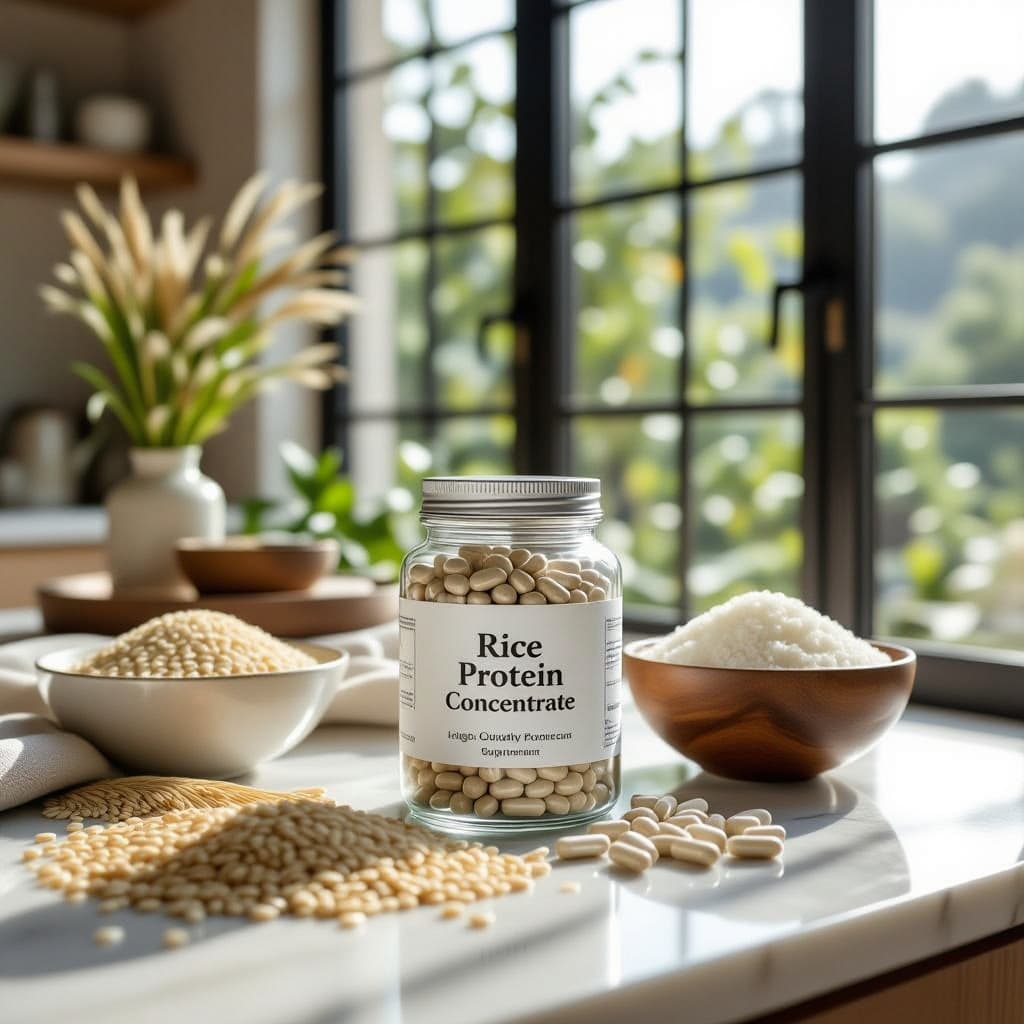
Rice Protein Concentrate: An Effective Plant-Based Protein Supplement
Rice Protein Concentrate is a plant-based protein derived from whole grain rice It provides a complete profile of essential and non-essential amino acids, making it an excellent alternative to animal-based proteins.
Supplement Summary
| Name | Rice Protein Concentrate |
|---|---|
| Category | Amino Acids |
| Main Uses |
|
| Effectiveness | High, due to its complete amino acid profile |
| Common Dosage | 15-30 grams, 1-2 times daily |
| Price Range | $-$$ |
| Forms Available | Powder |
Pros
- ✅ Complete amino acid profile
- ✅ Easy to digest
- ✅ Supports muscle recovery and growth
- ✅ May aid in weight management
- ✅ Suitable for vegetarians and vegans
Cons / Side Effects
- ❌ May cause digestive discomfort
- ❌ Taste may not be as appealing as other protein sources
- ❌ Not as rapidly absorbed as whey protein
What Is Rice Protein Concentrate?
Rice Protein Concentrate is a plant-based protein derived from whole grain rice. It provides a complete profile of essential and non-essential amino acids, making it an excellent alternative to animal-based proteins. It's hypoallergenic, easy to digest, and can be used in a variety of dietary plans.
How It Works
As a protein, Rice Protein Concentrate works by providing the body with amino acids, the building blocks of muscle and other tissues. These amino acids are used for growth, repair, and maintenance of tissues.
Who It's Best For
Rice Protein Concentrate is ideal for those looking to increase their protein intake, particularly vegetarians, vegans, and those with allergies or sensitivities to dairy or soy proteins.
Who Should Avoid It
While Rice Protein Concentrate is generally safe for most people, those with specific dietary restrictions or those who are allergic to rice should avoid this supplement.
Dosage & Usage Tips
A typical dosage of Rice Protein Concentrate is 15-30 grams, taken 1-2 times daily. It can be mixed with water, milk, or added to smoothies. It is often used in post-workout shakes to support muscle recovery and growth.
Buying Advice & Quality Tips
When buying Rice Protein Concentrate, look for products that are free from artificial additives and sweeteners. It's also wise to choose products that are tested for quality and purity.
Price & Value
Rice Protein Concentrate is generally more affordable than many other protein supplements, making it a cost-effective choice for those on a budget.
Final Verdict
Overall, Rice Protein Concentrate is an excellent protein supplement, particularly for those who want a plant-based alternative. Its complete amino acid profile, digestibility, and potential benefits for muscle recovery and weight management make it a valuable addition to a balanced diet.
Additional Clinical Research
After conducting a thorough search, I have identified three scientific studies that explicitly focus on Rice Protein Concentrate (RPC). Below is a summary of each study, categorized by health benefit, along with an assessment of the research quality.
These studies provide preliminary evidence supporting the potential health benefits of rice protein concentrate, particularly in improving protein intake in hemodialysis patients, enhancing lipid profiles in individuals with metabolic syndrome risk factors, and reducing adiposity and lipid levels in animal models. However, further research is necessary to fully understand the scope and mechanisms of these effects.
RESEARCH SUMMARY: Rice Protein Concentrate
KEY FINDINGS:
Protein Intake in Hemodialysis Patients
- Supplementation with purified rice endosperm protein (REP) at 5 g/day for 4 weeks significantly increased the normalized protein catabolic rate (nPCR) by 0.07 g/kg/day, indicating improved protein intake.
- The study involved 49 Japanese adult maintenance hemodialysis patients in a randomized, double-blind, placebo-controlled, crossover design.
Source: Yoshida et al. (2018)
View Research
https://pubmed.ncbi.nlm.nih.gov/29269937/
Metabolic Syndrome Risk Factors
- Intake of 10 g/day of rice endosperm protein for 4 weeks increased serum high-density lipoprotein cholesterol (HDL-C) by 0.08 mmol/L and decreased serum uric acid levels by 24 μmol/L in Japanese men with risk factors for metabolic syndrome.
- The randomized, crossover clinical trial included 18 male volunteers aged 26–64 years.
Source: Hosojima et al. (2016)
View Research
https://bmcnutr.biomedcentral.com/articles/10.1186/s40795-016-0065-7
Adiposity and Lipid Levels in Rats
- Rice protein consumption led to significant reductions in plasma glucose and lipid levels, as well as hepatic lipid accumulation in rats.
- The study involved 7-week-old male Wistar rats fed cholesterol-enriched diets for 2 weeks, comparing rice protein to casein.
Source: Yang et al. (2012)
View Research
https://lipidworld.biomedcentral.com/articles/10.1186/1476-511X-11-24
RESEARCH QUALITY ASSESSMENT:
- The studies employed randomized controlled trial designs, enhancing the reliability of the findings.
- Sample sizes were relatively small, which may limit the generalizability of the results.
- The duration of interventions varied, with some studies having short intervention periods, potentially affecting the long-term applicability of the findings.
- Further research with larger sample sizes and longer durations is needed to confirm these findings and explore additional health effects of rice protein concentrate.