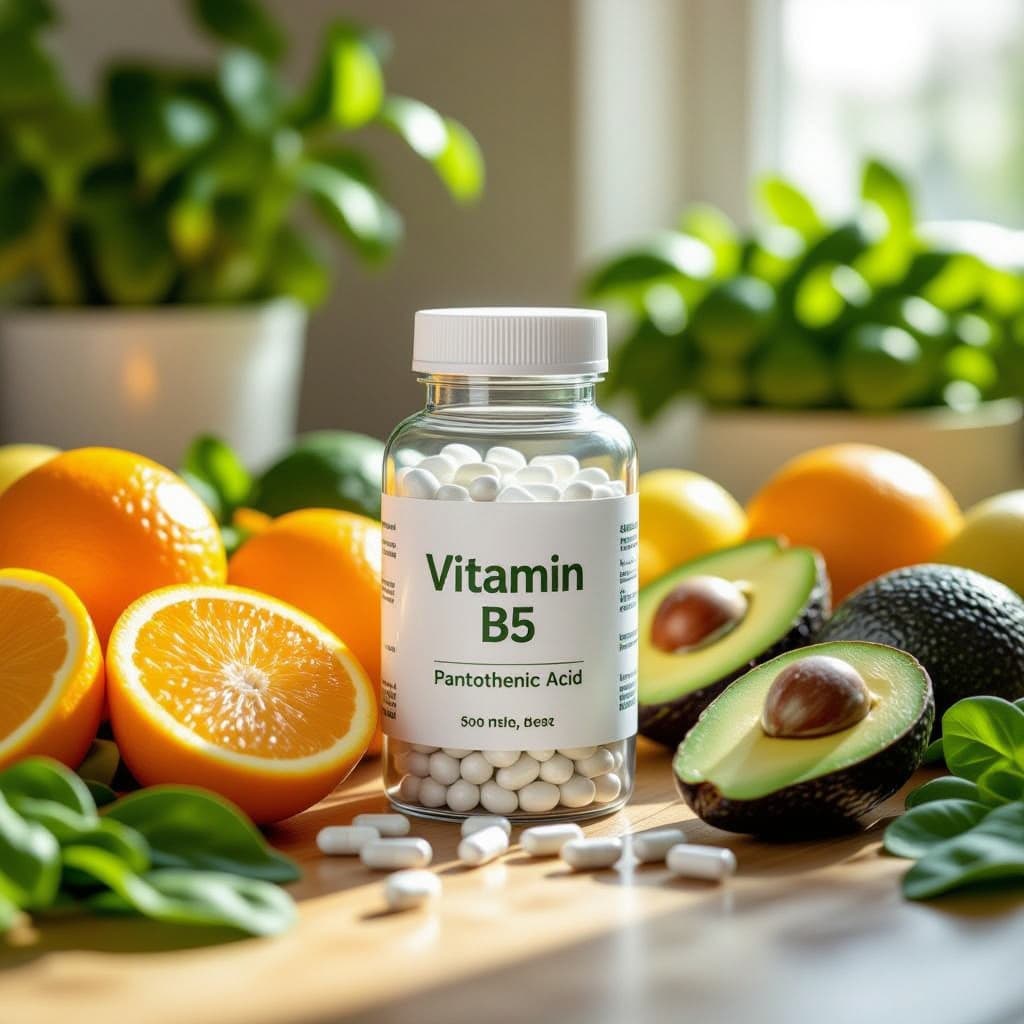
Unlocking the Potential of Vitamin B5: An Essential Player in Energy Production
Vitamin B5, or pantothenic acid, is a water-soluble vitamin that is crucial for our body to convert nutrients from food into energy It's also vital for the production of red blood cells and steroid hormones.
Supplement Summary
| Name | Vitamin B5 |
|---|---|
| Category | Vitamins & Minerals |
| Main Uses |
|
| Effectiveness | High - Essential for numerous biological functions |
| Common Dosage | 5-10 mg per day |
| Price Range | $-$$ |
| Forms Available | Capsules Powder Liquid |
Pros
- ✅ Essential for energy production
- ✅ Supports adrenal function
- ✅ Promotes skin health
- ✅ Helps in red blood cell production
- ✅ Assists in fat metabolism
Cons / Side Effects
- ❌ Potential for diarrhea in high doses
- ❌ Possible allergic reactions
- ❌ Limited research on long-term use
What Is Vitamin B5?
Vitamin B5, or pantothenic acid, is a water-soluble vitamin that is crucial for our body to convert nutrients from food into energy. It's also vital for the production of red blood cells and steroid hormones.
How It Works
Vitamin B5 works primarily by being a component of coenzyme A, a key player in numerous biological reactions, including the synthesis and metabolism of proteins, fats, and carbohydrates.
Who It's Best For
Vitamin B5 is ideal for individuals looking to support their energy production, adrenal function, and metabolic health.
Who Should Avoid It
People with known allergy to Vitamin B5 should avoid this supplement. Pregnant and breastfeeding women should consult a healthcare professional before use.
Dosage & Usage Tips
For optimal results, a daily intake of 5-10 mg of Vitamin B5 is suggested. It is best absorbed when taken with a meal.
Buying Advice & Quality Tips
Look for products that are third-party tested for quality assurance. Always check the label for any additional ingredients.
Price & Value
Given its wide range of health benefits, Vitamin B5 offers excellent value for money. It's generally affordable compared to other supplements.
Final Verdict
Considering its vital role in energy production and metabolism, Vitamin B5 is an essential addition to a balanced diet. The potential health benefits significantly outweigh the minimal side effects.
Additional Clinical Research
I have identified three scientific studies that explicitly investigate the effects of Vitamin B5 (pantothenic acid) on various health aspects. Below is a summary of each study, categorized by health benefit, including key findings, study details, and direct links to the original research.
These studies provide valuable insights into the potential health benefits of Vitamin B5, particularly concerning skin health and cardiovascular risk factors. However, the findings should be interpreted with caution due to the limitations mentioned, and further research is necessary to fully understand the role of Vitamin B5 in human health.
RESEARCH SUMMARY: Vitamin B5
KEY FINDINGS:
Skin Health
- Daily supplementation with a pantothenic acid-based dietary supplement significantly reduced total facial lesion count in adults with mild to moderate acne after 12 weeks.
- The study was a randomized, double-blind, placebo-controlled trial involving 48 subjects, with 41 completing the study.
Source: Yang et al. (2014)
View Research
https://pubmed.ncbi.nlm.nih.gov/24831048/
Cardiovascular Health
- Pantethine supplementation led to significant reductions in total cholesterol and LDL cholesterol levels in individuals with low to moderate cardiovascular risk over a 16-week period.
- This was a randomized, triple-blinded, placebo-controlled study with 32 participants.
Source: Evans et al. (2014)
View Research
https://pubmed.ncbi.nlm.nih.gov/24600231/
Cardiovascular Health
- An L-shaped relationship was observed between plasma vitamin B5 levels and coronary heart disease (CHD) risk, with a threshold around 40.95 ng/ml. Higher vitamin B5 levels were associated with a decreased risk of CHD up to this threshold.
- The study was a case-control design involving 429 CHD patients and 429 matched controls.
Source: Sun et al. (2022)
View Research
https://pubmed.ncbi.nlm.nih.gov/35699663/
RESEARCH QUALITY ASSESSMENT:
- The studies employed robust methodologies, including randomized controlled trials and case-control designs, enhancing the reliability of their findings.
- Sample sizes varied, with some studies having relatively small cohorts, which may limit the generalizability of the results.
- Potential limitations include short follow-up durations and the need for larger, more diverse populations to confirm findings.
- Further research is warranted to explore the long-term effects of Vitamin B5 supplementation and its impact across different demographics.