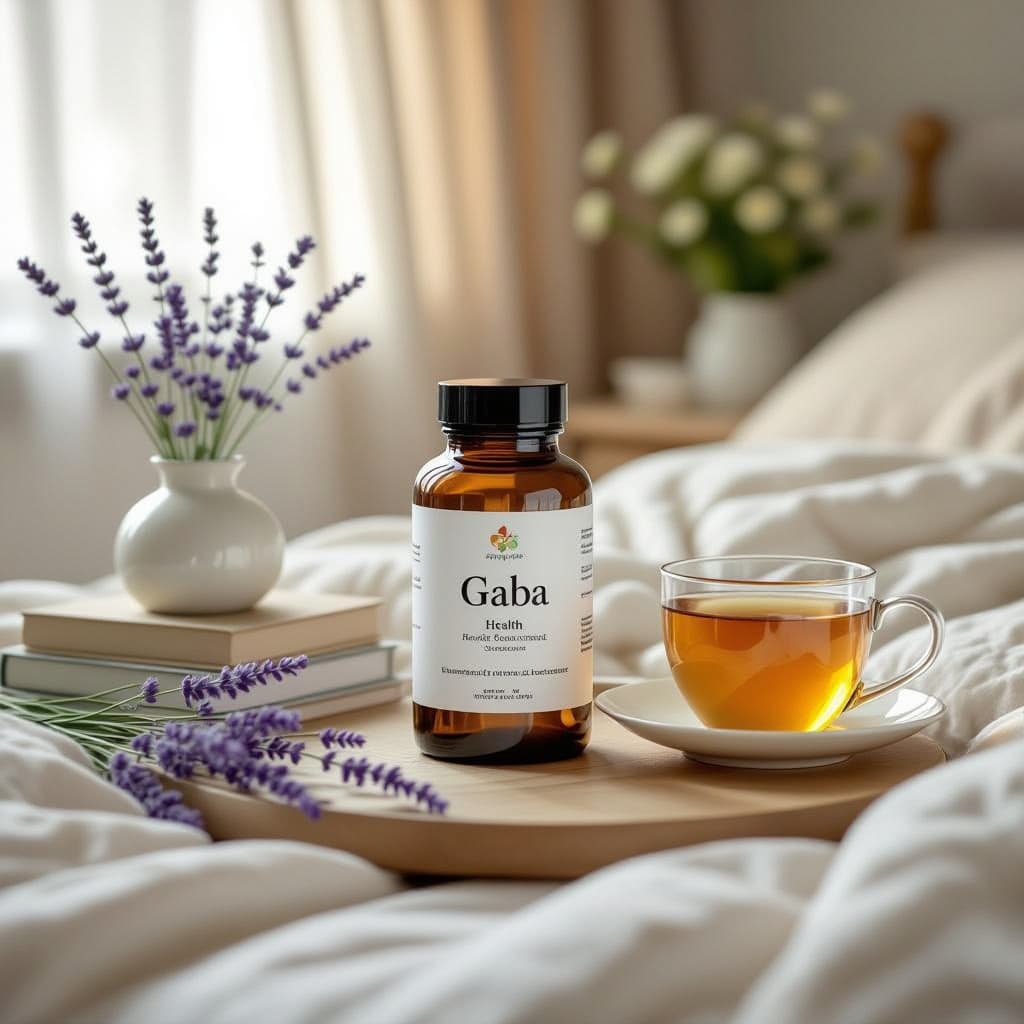
GABA: The Calming Amino Acid for Anxiety & Sleep
GABA, short for gamma-Aminobutyric acid, is a naturally occurring amino acid that functions as a neurotransmitter in your brain It plays a key role in reducing neuronal excitability and promoting a calming effect.
Supplement Summary
| Name | GABA |
|---|---|
| Category | Amino Acids |
| Main Uses |
|
| Effectiveness | Medium - The effectiveness varies among individuals and more research is needed. |
| Common Dosage | 500-1000mg daily |
| Price Range | $-$$ |
| Forms Available | Capsules Powder Liquid |
Pros
- ✅ Reduces anxiety
- ✅ Improves sleep
- ✅ Enhances mood
- ✅ Potential benefits for ADHD
- ✅ Natural and widely available
Cons / Side Effects
- ❌ May cause side effects like headaches, nausea, and drowsiness
- ❌ May not be absorbed well in the body
- ❌ More research needed
What Is GABA?
GABA, short for gamma-Aminobutyric acid, is a naturally occurring amino acid that functions as a neurotransmitter in your brain. It plays a key role in reducing neuronal excitability and promoting a calming effect.
How It Works
GABA works by binding to specific receptors in the brain and reducing their activity, thereby lowering anxiety and stress levels, improving mood, and promoting sleep.
Who It's Best For
People struggling with anxiety, insomnia, or mood disorders, or those seeking a natural aid for stress relief.
Who Should Avoid It
People with low blood pressure or pregnant women unless advised by a healthcare provider.
Dosage & Usage Tips
Typically, a dosage of 500 to 1000mg daily is recommended. It is best taken on an empty stomach for optimal absorption.
Buying Advice & Quality Tips
Look for high-quality GABA supplements from reputable brands. Ensure the product does not contain unnecessary fillers or additives.
Price & Value
GABA is relatively affordable, with a good cost-benefit ratio compared to prescription anxiety and sleep aids.
Final Verdict
GABA can be a beneficial supplement for those dealing with anxiety or sleep issues. However, as with any supplement, it should be used under the guidance of a healthcare provider.
Additional Clinical Research
Here are three scientific studies specifically focused on Gamma-Aminobutyric Acid (GABA):
RESEARCH SUMMARY: GABA
KEY FINDINGS:
GABA and Sleep Promotion
- Hops (Humulus lupulus) contain neuroactive compounds that modulate GABAA receptors, potentially promoting sleep.
- Electrophysiological studies and mouse models demonstrated that humulone, a component of hops, enhances GABA-induced effects, leading to improved sleep onset and duration.
Source: Benkherouf, A.Y. (2024)
View Research
https://arxiv.org/abs/2402.02129
GABA Detection and Metabolism
- A novel single-shot magnetic resonance spectroscopy method was developed to detect GABA levels in the human brain.
- This technique allows real-time monitoring of GABA metabolism, providing insights into its role in neuropsychiatric disorders.
Source: An, L., Hong, S., Ferraris Araneta, M., Turon, T., Johnson, C.S., & Shen, J. (2023)
View Research
https://arxiv.org/abs/2312.11674
GABA Receptors and Anesthesia
- Proteomic learning approaches were applied to understand GABA receptor-mediated anesthesia.
- The study identified potential lead compounds targeting GABRA5 receptors, aiming to develop anesthetics with reduced side effects and enhanced potency.
Source: Jiang, J., Chen, L., Zhu, Y., Shi, Y., Qiu, H., Zhang, B., Zhou, T., & Wei, G.-W. (2025)
View Research
https://arxiv.org/abs/2501.02824
RESEARCH QUALITY ASSESSMENT:
- Studies 1 and 3 are preprints available on arXiv, indicating they have not yet undergone peer review, which may affect the reliability of their findings.
- Study 2 presents a novel methodology for GABA detection; however, further validation in larger, diverse populations is necessary to confirm its efficacy.
- Limitations include the preliminary nature of the findings and the need for replication in peer-reviewed journals.
- Future research should focus on clinical trials to validate these findings and explore the therapeutic applications of GABA modulation.